


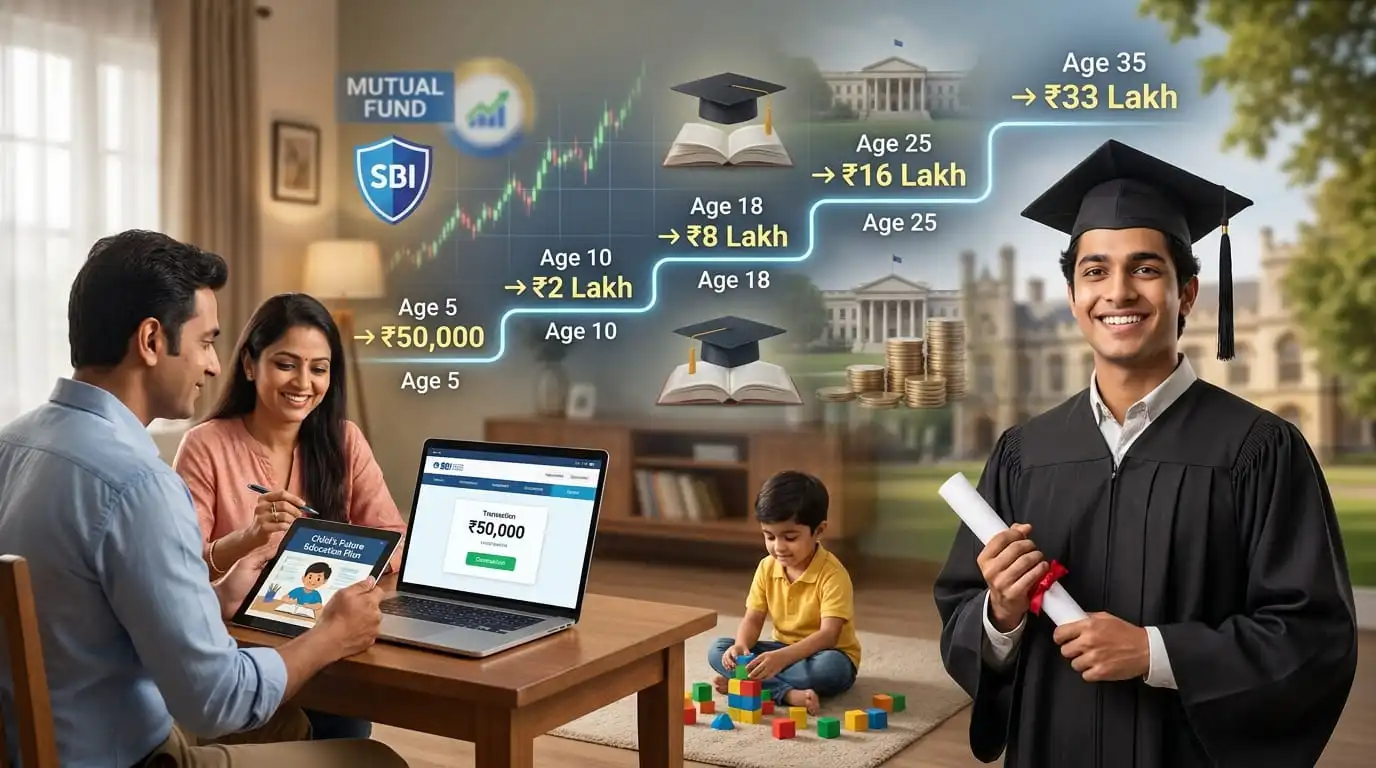
Every parent wants to give their child the best possible future. Whether it is higher education, studying abroad, starting a business, or getting married, these goals often require a significant amount of money. The challenge is that the cost of education and living expenses continues to rise every year. A degree that costs ₹10 lakh today may easily cost ₹20–25 lakh after 15 years.
This is why many parents start looking for dedicated child investment plans. Traditionally, people relied on fixed deposits, recurring deposits, insurance plans, or Public Provident Fund (PPF). However, over the last decade, mutual funds have become a popular choice because of their potential to generate inflation-beating returns over long periods.
One scheme that has attracted considerable attention is SBI Children’s Fund – Investment Plan, formerly known as SBI Magnum Children’s Benefit Fund. Designed specifically for long-term child-related goals, this fund combines disciplined investing with equity market exposure to help parents build wealth over time.
But is it really worth investing in? Can it help create a meaningful corpus for your child’s future? More importantly, how does it compare with alternatives such as Sukanya Samriddhi Yojana, PPF, or regular mutual funds?
Also See: Best Joint Life Insurance Plans for Married Couples
Let’s examine the scheme in detail.
SBI Children’s Fund at a Glance
| Feature | Details |
|---|---|
| Fund Name | SBI Children’s Fund – Investment Plan |
| Fund House | SBI Mutual Fund |
| Category | Solution Oriented Children’s Fund |
| Launch Date | September 2020 |
| Minimum SIP | ₹500 |
| Minimum Lump Sum | ₹5,000 |
| Lock-in Period | 5 Years or Child Attains Age 18 |
| Risk Level | Very High |
| Expense Ratio (Direct Plan) | Around 0.83%–0.90% |
| Fund Size (AUM) | More than ₹5,000 Crore |
| Suitable For | Long-Term Child Goals |
The fund has grown significantly since launch and has accumulated assets exceeding ₹5,000 crore, reflecting strong investor interest in child-focused mutual fund solutions.
What Is SBI Children’s Fund?
SBI Children’s Fund is a solution-oriented mutual fund designed specifically for parents who want to create wealth for their children’s future financial goals. Unlike a traditional savings account or fixed deposit, this fund invests a major portion of its portfolio in equities, which provides the opportunity for higher long-term growth.
The scheme is structured to encourage long-term investing by imposing a lock-in period. This feature prevents investors from making impulsive withdrawals during market volatility and helps them remain focused on their child’s future goals.
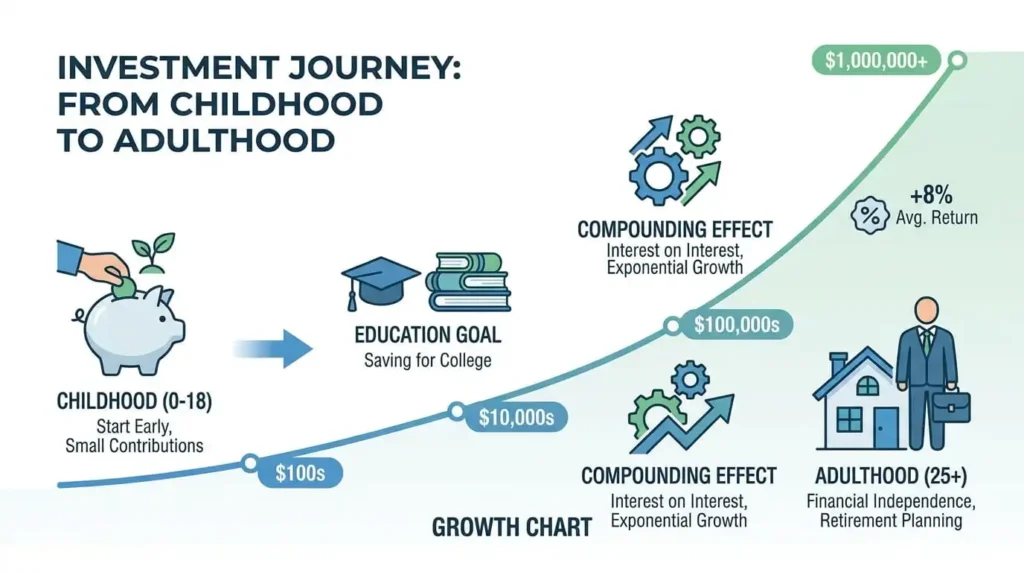
One of the biggest advantages of this approach is that it allows the power of compounding to work over many years. Even small investments made consistently can potentially grow into a substantial corpus when given enough time.
Why Child-Focused Investing Matters More Than Ever

Many parents underestimate how quickly education costs increase over time. Inflation in education often grows faster than general inflation. Engineering, medical, management, and international education programs are becoming increasingly expensive every year.
Consider a simple example. If a course costs ₹10 lakh today and education inflation averages 8% annually, the same course could cost more than ₹31 lakh after 15 years.
This is why simply saving money is often not enough. Investments need to grow faster than inflation to preserve purchasing power. Child-focused mutual funds attempt to address this challenge by investing in growth-oriented assets such as equities.
Also see: Single Premium Joint Life Insurance Plan
How the Lock-in Period Works
The lock-in period is one of the most misunderstood features of SBI Children’s Fund.
The scheme remains locked for:
5 years from the date of investment OR until the child reaches 18 years of age, whichever occurs earlier.
For example, if a child is 15 years old when the investment is made, the lock-in will end when the child turns 18, which is after three years.
On the other hand, if the child is five years old when the investment starts, the lock-in period will end after five years even though the child is still a minor.
This structure helps investors stay disciplined while also providing flexibility depending on the child’s age.
Portfolio Analysis: Where Does the Fund Invest?
One area that many articles fail to explain is what investors actually own when they invest in this fund.
The portfolio contains a diversified basket of stocks across multiple sectors. Major holdings have included companies such as State Bank of India, Alphabet, Muthoot Finance, Hatsun Agro Products, and Thangamayil Jewellery, among others.
Rather than depending on a single sector, the fund spreads investments across financial services, consumer businesses, technology, manufacturing, and other industries.
This diversification reduces concentration risk and helps the fund participate in multiple growth opportunities within the economy.
Historical Performance: What Do the Returns Tell Us?
Performance is one of the primary reasons investors become interested in this scheme.
Recent data shows that the fund has delivered strong returns compared with many peers in the children’s fund category. Three-year annualized returns have been above 24%, while since-launch returns have exceeded 30% in certain periods.
However, investors should be careful when interpreting these numbers.
Past performance does not guarantee future performance. Mutual funds go through different market cycles. A fund that performs exceptionally well during a bull market may deliver lower returns during periods of economic uncertainty.
Instead of focusing only on historical returns, investors should evaluate whether the fund matches their risk tolerance and investment horizon.
Can ₹50,000 Really Become ₹33 Lakh?
This is one of the most popular claims seen in videos and promotional discussions.
Technically, yes—it is possible under certain assumptions.
If ₹50,000 grows at an annualized rate of around 15% for 30 years, the final corpus can exceed ₹33 lakh due to compounding.
However, there are two important realities investors should understand.
First, mutual funds do not guarantee returns. A 15% return is merely an assumption used for illustration.
Second, returns are rarely consistent. Some years may generate 20% gains, while others may produce negative returns.
Therefore, investors should treat such projections as examples rather than promises.
Risk Analysis: The Part Most Investors Ignore
Many people focus entirely on returns and forget to evaluate risk.
SBI Children’s Fund falls into the high-risk category because of its significant equity exposure. This means the value of your investment can fluctuate substantially in the short term.
During market corrections, temporary declines of 20–30% are possible.
For example, an investment worth ₹10 lakh today could temporarily fall to ₹7–8 lakh during a severe market downturn. Investors who panic and withdraw money during such periods often miss the eventual recovery.
This fund is therefore more suitable for investors with long investment horizons who can tolerate short-term volatility.
Taxation Rules
Taxation is another important factor that many investors overlook.
Since the fund is equity-oriented, capital gains are taxed according to prevailing equity mutual fund tax rules.
Short-term capital gains and long-term capital gains are treated differently depending on the holding period and current tax regulations.
Because tax laws may change over time, investors should always verify the latest rules before making redemption decisions.
SBI Children’s Fund vs Sukanya Samriddhi Yojana
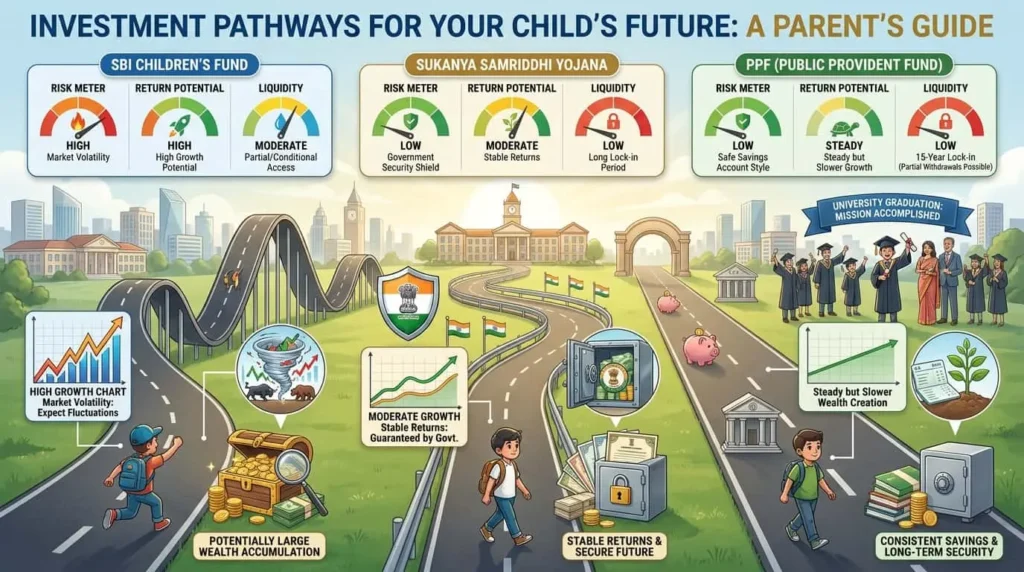
Many parents compare this fund with Sukanya Samriddhi Yojana (SSY).
While both are designed for long-term child-related goals, they operate very differently.
SSY offers government-backed safety and predictable returns. However, returns are fixed by the government and may not always beat long-term equity market returns.
SBI Children’s Fund, on the other hand, offers potentially higher growth because it invests in equities. The trade-off is higher risk and uncertainty.
For parents with a girl child, combining SSY with equity investments may provide a balanced approach.
SBI Children’s Fund vs PPF
PPF is one of India’s most trusted long-term savings instruments.
The biggest advantage of PPF is capital safety. However, its returns are generally lower than what equity mutual funds have historically generated over long periods.
Parents seeking maximum safety may prefer PPF, while those aiming for higher long-term growth may find SBI Children’s Fund more attractive.
The choice ultimately depends on risk appetite and financial goals.
Advantages of SBI Children’s Fund
One of the strongest features of this scheme is its goal-oriented structure. The lock-in period helps investors remain committed to long-term objectives instead of reacting emotionally to market fluctuations.
The fund also benefits from professional management and a diversified portfolio.
Another advantage is accessibility. With a minimum SIP requirement of just ₹500, even small investors can start building a corpus for their child.
The scheme has also demonstrated strong performance since launch compared with many funds in its category.
Limitations You Should Know
No investment product is perfect.
The biggest drawback is market risk. Returns are not guaranteed, and investors must be prepared for volatility.
The lock-in period may also be inconvenient for individuals who require liquidity.
Additionally, some investors argue that similar long-term goals can also be achieved through carefully selected diversified mutual funds without the restrictions of a dedicated child fund. Community discussions often highlight this perspective when comparing child funds with broader equity options.
Who Should Invest?
This fund may be suitable for:
- Parents planning for higher education.
- Investors with a horizon of 10 years or more.
- Families comfortable with equity market fluctuations.
- Individuals seeking inflation-beating growth potential.
Who Should Avoid It?
This scheme may not be ideal for:
- Investors seeking guaranteed returns.
- People needing money within the next few years.
- Extremely conservative investors.
- Those uncomfortable with temporary market declines.
Final Verdict
SBI Children’s Fund has emerged as one of the most prominent child-focused mutual fund schemes in India. Its strong historical performance, disciplined structure, and long-term wealth creation potential make it an attractive option for parents planning future financial goals such as education, marriage, or career development.
However, investors should avoid being influenced solely by projections that show small investments growing into massive amounts. Such outcomes depend on future market performance and cannot be guaranteed.
Viewed realistically, the fund’s greatest strength is not the possibility of extraordinary returns. Instead, it is the combination of disciplined investing, long-term compounding, and goal-based financial planning that can help parents prepare for some of the most important milestones in their child’s life.
If you have a long investment horizon and can tolerate market volatility, SBI Children’s Fund deserves a place on your shortlist. If capital safety is your highest priority, alternatives such as PPF or Sukanya Samriddhi Yojana may be more appropriate.
Frequently Asked Questions (FAQs)
Is SBI Children’s Fund a safe investment for my child’s future?
SBI Children’s Fund is managed by SBI Mutual Fund and regulated by SEBI, but it invests primarily in equities. While it has the potential to generate higher long-term returns, it is subject to market risks and does not guarantee returns.
What is the lock-in period in SBI Children’s Fund?
The fund has a lock-in period of 5 years or until the child reaches 18 years of age, whichever is earlier. This feature encourages disciplined investing for long-term goals such as education and marriage.
Can I start investing in SBI Children’s Fund through SIP?
Yes, investors can start a SIP with as little as ₹500 per month. A lump sum investment can be started with a minimum amount of ₹5,000.
Is SBI Children’s Fund better than Sukanya Samriddhi Yojana (SSY)?
Both serve different purposes. SSY offers government-backed safety and predictable returns, while SBI Children’s Fund provides market-linked growth potential. Investors seeking higher long-term returns may prefer SBI Children’s Fund, while conservative investors may favor SSY.
Can I withdraw money before the lock-in period ends?
No, investments generally remain locked until the completion of the lock-in condition. Investors should therefore invest only if they can stay invested for the intended long-term period.
Disclaimer: This article is for informational and educational purposes only and should not be considered investment advice. Mutual fund investments are subject to market risks, and past performance does not guarantee future returns. Investors should read all scheme-related documents carefully and consult a qualified financial advisor before making investment decisions.